Quick conclusion
Box beam Composite/FRP can be processed into benches, picnic tables, and outdoor table and chair sets. with components such as seat surface, tabletop, legs, and braces. MaterialIt has a low weight and does not rust like carbon steel, making it suitable to consider in damp areas, coastal locations, or places that require frequent cleaning. However, the finished product still needs to be checked for user load, span, deflection, stability against tipping/sliding, connections, contact edges, surface, UV resistance, and anchoring method. There is no single standard for bars or loads suitable for all chair models.
What type of Composite/FRP seating does this guide cover?
The phrase “composite table and chairs” on the market can refer to many different products. FRP pultrusion profile is a glass fiber reinforced polymer formed into box sections, angles, or other profiles; the sections are cut, drilled, and connectedconnect to create a frame, seat surface, or tabletop. Monolithic FRP is molded into the chair shell or complete part. WPC is woodcomposite plastic, usually containing wood powder and polymer, leaning towards wood-like boards or decorative strips.
This article focuses on chairs and tables used Box beam Composite/FRP of Hưng Thịnh Phát, not to be equated with molded plastic chairs or WPC wooden-plastic tables and chairs. The material name alone does not determine load-bearing capability; see the foundation specifications at Purlin product page Composite/FRP box-section bar.
When should FRP tables and chairs be considered?
- Coastal areas, swimming pools, resorts, and piers: need to limit rust on the main bars and contact surfaces.
- Fish ponds, factories, and water treatment areas: environment is frequently humid, with salt or corrosive agents; specific chemicals still need to be confirmed.
- Parks, gardens, and outdoor activity areas: Need picnic tables or benches that are easy to clean and can be produced to size.
- Items that need to reduce transport weight: FRP profiles can be convenient for moving components to rooftops, islands, pond edges, or places difficult for forklifts to access.
- Areas that need to minimize exposed steel parts: Bolts, screws, plates, and anchors must still be selected according to the actual environment.
Structure of picnic tables and bench seats with FRP box beams
A picnic table set may consist of tabletop planks, seat planks, and legstilted or standing legs, horizontal bracing, diagonal bracing, base plates, and bolts. Independent benches can be equipped with backrests, armrests, and anchor legs. The width of the gaps between the slats must allow water to drain while preventing the risk of hands or objects getting stuck depending on the user group.
The seat and tabletop surfaces are subjected to bending between the support points; the legs and braces provide stability; connections transfer force between each member. A small change in the length of the bench, the distance between legs, or the position of bolts can significantly alter deflection, stress, and user experience.
Eight groups of data needed before selecting specifications
| Data group | Content to confirm | Risks if ignored |
|---|---|---|
| User | Adults, children, public or private; expected number of people per seat | Choosing the wrong load level and size |
| Geometry | Length, width, seat/table top height, leg spacing, whether it has a backrest or not | Excessive sagging or improper sitting posture |
| Load and impact | Person load, concentrated load, uneven sitting, leaning, pushing and pulling, and expected impact | Overloading bars or joint nodes |
| Stable | Freely placed or anchored to the ground, flat or sloped surface, risk of tipping and sliding | Tilting, sliding, or vibrating during use |
| Environment | UV, rain, salt, chlorine, chemicals, temperature, and exposure time | Wrong choice of resin system or surface |
| Contact safety | Edge rounding, bar ends, anti-slip surfaces, gaps, and hand clamp points | Skin scratches, hand pinch or tripping |
| Connection | Hole diameter, edge distance, washergrommet, base plate, tightening moments, and metal materials | Crushed into bars, cracked or delaminated |
| Product documentation | Cross-section, thickness, mechanical properties, fiber direction, resin system, and test data for the correct profile | Using data from another product by mistake |
Load capacity, sagging, and stability
Load capacity should not be disclosed based solely on the outer dimensions of the bar. Specifications must be checked according to real rhythm, profile setting method, person load, eccentric load, deflection limit, linkage, and anchoring conditions. ISO 7173:2023 provides methods for determining the strength and durability of chairs and stools; ISO 7174-1:1988 addresses the stability of high chairs and stools. The scope of application must correspond to the correct type of table and chair and the target market.
For components and connections made from FRP pultrusion profiles, ASCE/SEI 74-23 is a reference source for FRP pultrusion structural design. This standard does not replace testing of complete bench and table products, applicable interior standards, or the design engineer's responsibility for verification.
- Finalize the usage dimensions, number of seats, and position of legs/braces.
- Determine loads, load combinations, and deflection criteria according to project standards.
- Use the confirmed mechanical properties of the correct profile Hưng Thịnh Phát.
- Check seating bars, tabletops, legs, braces, and anti-tip stability.
- Check drilled holes, base plates, bolts, beam ends, and foundation anchors.
- Approve actual samples before mass production.
Images of Composite/FRP tables and chairs at the site
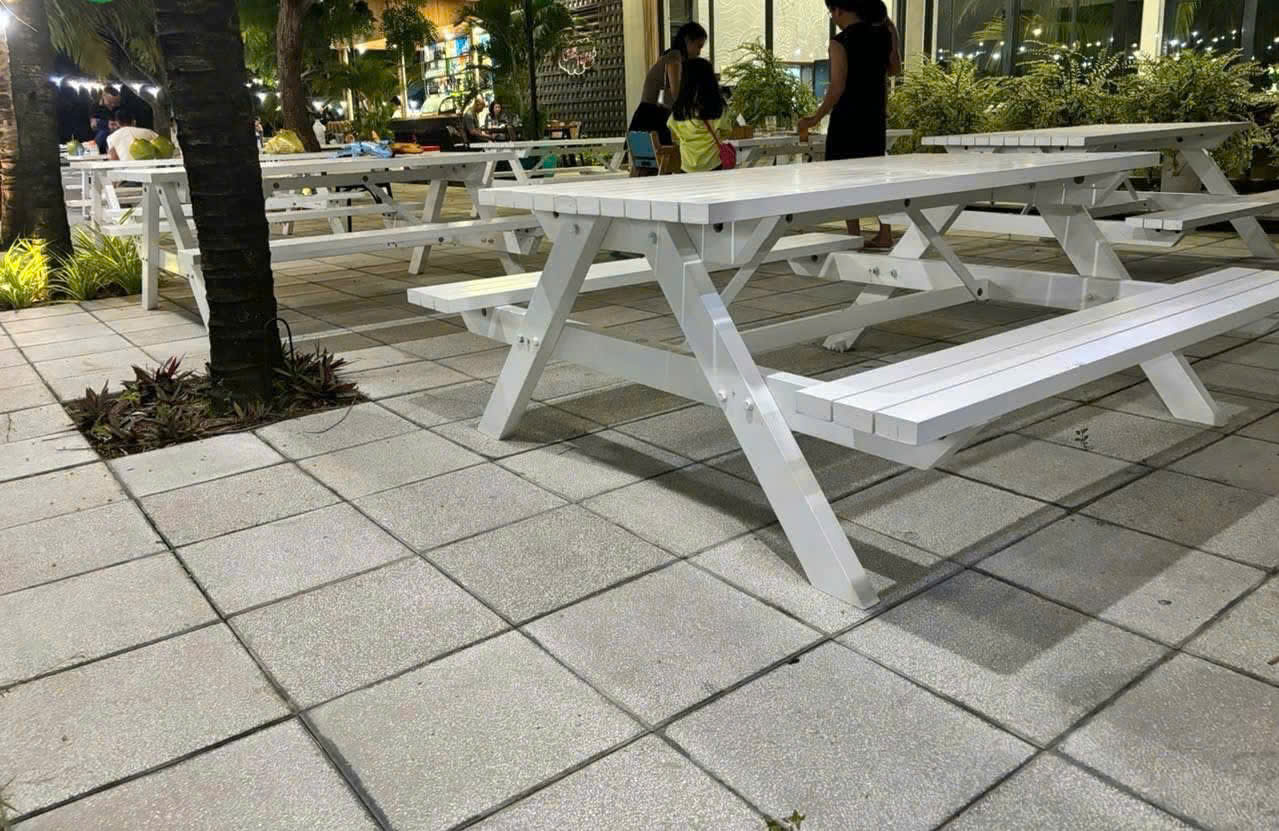
The representative photo shows white picnic table sets made from Composite/FRP profiles and placed outdoors. The photo illustrates the arrangement of table tops, seats, legs, and braces; this is evidence of the practical application of Hưng Thịnh Phát, not a load certification for all sizes or usage conditions.
Send drawings, dimensions, number of seats, usage environment, anchoring requirements, color, and quantity to Hưng Thịnh Phát to check production feasibility.
Send a quotation requestOutdoor resin system, surface, and UV
FRP does not form rust like carbon steel, but "corrosion resistance" does not mean resistance to all chemicals or maintenance-free. Suitability depends on the resin system, surface layer, chemical concentration, temperature, UV exposure, and contact time. ISO 4892-3:2024 specifies the method for exposing plastic samples to fluorescent UV light, heat, and water to simulate certain weather effects; results are only meaningful for the exact sample and cycle tested.
Strongwell's technical guidelines also note that UV can affect FRP and that protection should be considered according to the final usage conditions. Therefore, the quotation file should confirm the resin system, UV inhibitors or surface protection, color, roughness, and aesthetic requirements. Cut ends, drilled holes, and exposed fiber locations must be treated.according to the appropriate procedure.
Processing, installation, and safe use
- Drawings and sample approval: Confirm height pins, slot gaps, edge radii, color, surface, and connection details before mass production.
- Control cutting and drilling: Use tools, vacuum the fibers, and wear appropriate protective equipment; avoid drilling arbitrarily close to the edge of the beam.
- Force distribution at the joint: Use appropriate plates and washers; do not overtighten causing profile wall crushing.
- Remove sharp edges and exposed fibers: Capping the bar ends, handling three-way joints, rounding edges, and checking clamp points before delivery.
- Foundation and anchor inspection: Freely placed tables and chairs must be stable; products that are anchored to the ground need confirmation of the foundation, anchor bolts, drainage, and maintenance removal capability.
- Acceptance with actual sample: assess vibration, sag, stability, and touch sensation before scaling up.
Cleaning and maintenance of FRP tables and chairs
- Regularly check for loose bolts, misaligned legs, vibration, cracks, delamination, surface wear, and exposed fiber ends.
- Observe fading, chalking, or surface layer degradation in direct sunlight.
- Clean salt, mud, food, and chemicals with a detergent compatible with the plastic system; test on a small area first before widely used.
- Do not drag tables and chairs over uneven surfaces if the leg design is not intended for that.
- Re-evaluate when changing location, base placement, anchoring method, number of users, or adding accessories.
See more Overview guide on FRP purlins for corrosion-resistant projects, Application of FRP box beams as fences, purlin Composite used as fish raft and Purlins Composite used as roof, brace.
Documents needed to send for quoting Composite/FRP tables and chairs
The quotation depends on the profile, thickness, length, type of plastic, color, surface, quantity, level of processing, connection, and delivery location. To avoid incorrect specifications, please send:
- Drawings or sample photos included length, width, height, number of seats, and leg/bracing position.
- Installation location, indoor/outdoor, UV level, humidity, salt, chlorine, chemicals, and temperature.
- Users, load requirements, acceptance standards, and sample testing requirements if any.
- Free placement or anchored; type of surface, anchoring details, metal accessories, and assembly/disassembly requirements.
- Color, surface, quantity, packaging, delivery location, and schedule.
Technical reference source
- ISO/TC 136 – Furniture catalogue: official catalog has ISO 7173:2023 on durability and long-lasting strength of chairs and stools.
- ISO 7174-1:1988: method for determining the stability of standing chairs and stools within the scope of the standard.
- ISO 4892-3:2024: method of exposing plastic samples to fluorescent UV light, heat, and water.
- ASCE/SEI 74-23: design components, connections, and assembled products using FRP pultrusion profiles.
- Strongwell technical FAQs: note about the impact of UV and selection of protective measures for FRP according to intended use.
Technical limits: This article supports screening solutions and preparing dossiers. The final specifications must be based on drawings, applicable standards, usage conditions, and test data of the correct product Hưng Thịnh Phát; the designer is responsible for confirming for the specific product and project.
Contact Hưng Thịnh Phát for consultation on specifications and pricing at the factory.